
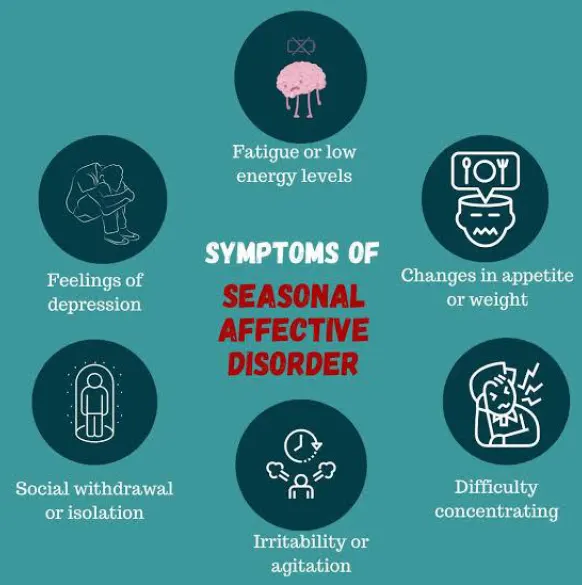
Diagnosis code: F33.9 - (Major depressive disorder, recurrent, unspecified)
Seasonal Affective Disorder (SAD) is a type of major depressive disorder that occurs during certain times of the year, most commonly beginning in the fall or winter months and improving during the spring and summer. As the days grow shorter and the amount of daylight decreases, changes in the body’s internal clock and other biological processes may affect sleep, energy, and mood. While it is normal for energy levels to drop and mood to shift as the seasons change, SAD involves symptoms that are more persistent and can begin to interfere with daily functioning.
Seasonal Affective Disorder can affect anyone, but it is reported more frequently among women, occurring approximately four times more often in women than in men. Research also suggests that younger adults and people living farther from the equator may be at greater risk.
Treatment for SAD may include light therapy, psychotherapy, and antidepressant medication, depending on an individual's symptoms and needs. Light therapy uses artificial light to provide exposure during periods of reduced daylight and is typically most beneficial when used in the morning. Cognitive-Behavioral Therapy for SAD (CBT-SAD) incorporates cognitive-behavioral techniques to challenge negative thoughts and beliefs related to seasonal changes while also encouraging healthy activities. Antidepressants, including SSRIs, may also be used to treat SAD.
If you notice a recurring pattern of depressive symptoms during a particular season, speaking with a mental health professional can help determine whether SAD may be contributing to what you are experiencing.
Article by Naomi Puder, B.A.
References:
Castillo Cruz, R., & Rohan, K. J. (2025).
Sudden Gains in Cognitive-Behavioral Therapy for Seasonal Affective Disorder.
Cognitive Therapy & Research, 49(6), 1203–1215.
https://doi-org.libaccess.fdu.edu/10.1007/s10608-025-10616-y
Melrose S. (2015).
Seasonal Affective Disorder: An Overview of Assessment and Treatment Approaches.
Depression research and treatment, 2015, 178564.r
https://doi.org/10.1155/2015/178564
Article by Paul Spergel Ph.D, LPC
Please call us at (973) 527-7072 or fill out the form below.
Chester Psychotherapy Group
230 RT 206 Building 3, Suite 1
Flanders NJ 07836
NJ License#: 37PC00225800
NY License#: 002829
Phone: (973) 527-7072
Fax: (973) 527-7073
Monday-Thursday: 10am to 8pm
Friday: 10am to 6pm
Saturday: 9am to 1pm